

Bornean Orangutan Conservation in Sabah – Facts, Habitat, and Reforestation Efforts
Written by Aleena Che Ramli
Orangutan – “Person of the Jungle”
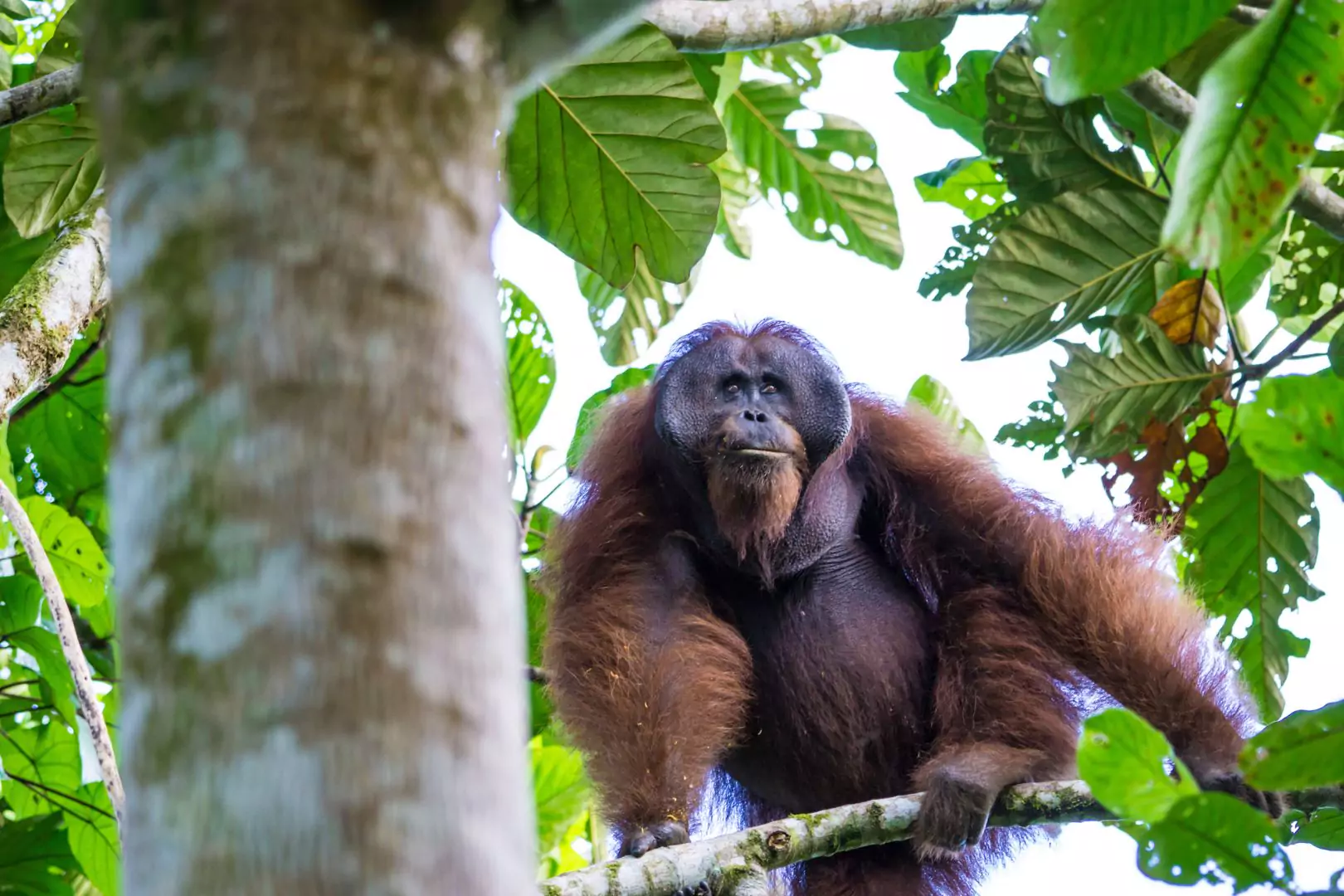
Orangutan simply means “Person of the Jungle” in the Malay language. Orangutans belong to the Great Apes family, joining the primates of gorillas, bonobos, and chimpanzees—none of which have tails. They have proportionally long and strong arms that help them swing from one branch to another. Their legs are short, and they have beautiful russet-shaded hair. As the male orangutan becomes an adult, it develops distinctive cheek pads or flanges. Vocally, they make long calls to attract females or to intimidate rivals, while younger males do not make such calls and almost replicate the features of adult females.
During the Pleistocene, orangutans were once spread across the forests of Southeast Asia and South China. Today, they are only found on the islands of Sumatra and Borneo.
Orangutan Species
Bornean Orangutan (Pongo pygmaeus)
The Bornean orangutan is further divided into three subspecies:
- Pongo pygmaeus pygmaeus – northwest populations
- Pongo pygmaeus morio – east populations
- Pongo pygmaeus wurmbii – southwest populations
The Bornean orangutan is endemic to the island of Borneo, found in both Malaysian states of Sabah and Sarawak as well as in Kalimantan, Indonesia. It differs in appearance from the Sumatran orangutan, with a broader face, shorter beard, and slightly darker colouration. While primarily arboreal, Bornean orangutans occasionally move on the ground—unlike the Sumatran orangutans, which share their habitat with tigers.
Sumatran Orangutan (Pongo abelii)
The Sumatran orangutan is found only in the north of the Indonesian island of Sumatra. They have longer facial hair, smaller faces, and thinner builds than the Bornean orangutans. They also exhibit closer social bonds and can often be seen gathering in groups to feed on fruit trees.
Tapanuli Orangutan (Pongo tapanuliensis)
The rarest of all great apes, the Tapanuli orangutan was discovered in 1997 during an orangutan survey. Found in North Sumatra, fewer than 800 individuals remain, making it the most endangered great ape species in the world. They have smaller heads, frizzier hair, and flatter faces compared to the other species. The Tapanuli orangutan is confined to 475 square miles of upland forest in the Batang Toru ecosystem and has been isolated for over 10,000 years (WWF, 2017).
Character and Behaviour
Orangutans are highly intelligent with excellent memories. As they roam the rainforest, they form mental maps of their home range to track food sources throughout the seasons. A typical day for an orangutan involves travelling, feeding, and resting.
Diet
Orangutans forage primarily for fruit and leaves, with figs, durian, and jackfruit being favourites. They also consume bird eggs, insects, bark, honey, and small vertebrates such as the slow loris. Depending on their location, they may eat soil and minerals to counteract plant toxins. Orangutans often visit natural clay licks to supplement their diet with kaolin, which helps neutralise tannins (Rijksen & Meijaard, 1999).
Nest Building
Orangutans are meticulous nest builders. They construct new nests daily, using leafy branches and large leaves for protection against rain or sun. Young orangutans learn by observing their mothers and become proficient nest builders by the age of three.
Life Cycle
Orangutans have one of the slowest reproduction rates among primates. The gestation period is about eight and a half months, and females give birth only once every 7–8 years. The bond between mother and baby is strong, as the infant is completely dependent for the first few years. Orangutans typically live up to 45 years in the wild.
Bornean Orangutan in the Forest
The Bornean orangutan inhabits tropical rainforests across Sabah, Sarawak, and Kalimantan. They spend most of their lives in trees, building daily nests 15–100 feet high. Over 90% of their diet is sourced from forest canopies. As key seed dispersers, they play a vital ecological role in maintaining healthy forests.
Deforestation and Threats
Deforestation driven by logging and oil palm expansion is the primary cause of habitat loss. Fires and illegal hunting exacerbate the decline. Between 1999 and 2015, Borneo lost an estimated 150,000 orangutans (BBC News, 2018). Current population estimates are: Bornean orangutans ~104,700 (endangered), Sumatran ~7,500 (critically endangered), and Tapanuli ~800 (most endangered). In Sabah alone, around 11,000 individuals remain (WWF, 2018).
Reforestation for the Orangutan in Sabah
Between the 1980s and early 2000s, logging, fires, and forest fragmentation drastically reduced orangutan habitats. Sabah’s reforestation efforts—led by WWF, Sabah Forestry, and local partners—have restored large areas such as Bukit Piton Forest Reserve in Lahad Datu. After 13 years, orangutans have returned, building nests and foraging in the replanted trees.
Inspired by these successes, Brothers Cycling (a non-profit organisation based in Switzerland) and HAK’s World Travel & Hospitality (formerly Bike and Tours) launched a joint reforestation project in 2017. The initiative covers 40,000 m², focusing on planting wild fruit and dipterocarp trees with five years of maintenance to ensure growth.
Why Long-Term Maintenance Matters
In Sabah’s fast-growing environment, seedlings face intense competition from creepers and grass. Without consistent maintenance, saplings can quickly be overtaken and die. Long-term care—including clearing, replanting, and protection from wildlife—is crucial to ensure forest restoration success.
The Future of Borneo’s Orangutans
Ultimately, the goal is to enrich the living habitat of the endangered Bornean orangutan. Despite challenges from the Covid-19 pandemic and funding constraints, the reforestation work at Bukit Piton continues. With your support, we can expand the project to 100,000 m² by 2026, giving orangutans a fighting chance to thrive once again.
Support Reforestation in Sabah
Help us restore Bukit Piton’s forest for the endangered orangutan.
Your donation supports local conservationists, long-term maintenance, and the survival of Sabah’s “Person of the Jungle.”
Return to Sabah – Natural Wonders of Borneo and explore more unforgettable destinations — from Danum Valley and Kinabatangan River to Maliau Basin, the islands, and beyond.

About the Writer
Aleena Che Ramli
🔎 Motivational Speaker | 🔎 Certified Professional Coach (TCI & IAC-MP) | 🔎 Accredited Trainer
A resilient and passionate professional who believes in living with vision, not just sight. Aleena combines her background in coaching and training with storytelling that inspires connection and purpose.